Showing posts with label ethics. Show all posts

Friday, May 27, 2011

Cigarettes, Pumping Gas, Moronic People: Signs Our Country Is Going Crazy?


I thought this was something that was so moronic, that no one would ever even consider the possibility of something like this happening in real life because common sense and LIFE SAVING INSTINCT would prohibit it:


But NO. Today, as I was pumping my gas in a local grocery story gas station, I saw a woman and her daughter lighting up as they were pumping gas. At first, I was struck with the sensation of, "Why you dumb b****es!" But then I realized, "Wow, they could really catch this place on fire." So I decided to approach them, as calmly as I could, considering my innards were shaking with anger at their idiocy. I said, "Are you aware you can catch this place on fire with that lighter and those cigarettes?"
"Yes" said the very obvious chain smoker with sagging skin, wrinkled lips, and charred complexion.
"Do you care that you could kill everyone here?"
"I'm aware, okay?"
"So why aren't you a little accountable for the lives of everyone around here, okay?"

She got angry and started to walk towards me so I ran inside and told the attendent. Just FYI to you readers, smoking and pumping gas is illegal. I told him that some insane woman outside was smoking and pumping and he also freaked out, but laughed pretty hard too. I went back outside with my mother, both of us talking quite loud,
"How could you be so stupid?"
"Seriously, don't they know that is illegal?"
"Well at least they are on camera."
"Oh I hope she heard me."

Seriously. ACCOUNTABILITY folks. If there is one thing I Can-not-stand, it must be incompetence. If you are not awake enough to realize that you could possibly kill someone because of your own addiction, carelessness, or incompetence, you do not deserve the same freedoms the rest of us have. This kind of moronic behavior is something I do not tolerate (clearly). I feel a duty to my fellow human and myself; if we are in this game of evolutionary russian roulette, I want to make sure that we have the best odds of survival. I am not afraid to raise my voice when something I see is life-threatening.

Funny enough, in my near shaking anger as I drove away (as I heard the woman b***h about how I "didn't have the right to tell someone how to live" --hunny, I have the right to try to stay alive), I thought of America. It is kind of a political jump to make. Basically, is this the kind of behavior America is coming to? I didn't know who to blame. I jumped to stereotypes: Conservatives for their "freedom" and "no intervention" ideology, or liberals with their "rights for all" and "entitlement" and "welfare state." I might have had five different bad radio talk shows going on in my head and finally realized (whilst listening to Beyoncé's "Single Ladies) that it wasn't anyone's fault but that one person, for not having the common sense to stave off her addiction for 5 minutes to pump gas. Seriously, it wasn't political. It was just life.

So my moral of the story? If you see behavior that could harm others and kill everyone in an instant, don't make a political charade out of it. Change that behavior.

Commonsense.


Thursday, May 26, 2011

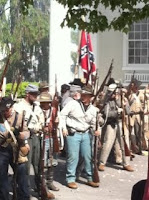
Civil War Reenactments


This year marks the 150th anniversary of America's "War Between the States" (not the "Civil War" according to the Prussian General actor at one reenactment). Unlike perhaps other countries who hold moments of silence for their some 500,000 who died in war, Americans like to celebrate the history and symbolism of this war by reenacting it.

As one dear friend said, "A sitting African-American President from Illinois (who sounds more and more Lincolnesque) at the same time of Civil War Reenactments. Strange times indeed." And rightly said. At a time in American history where we have powerful blacks, women, minorities, Southerners, Northerners, and many troops on ground abroad fighting very bloody wars, you would think Americans would not feel a need to constantly celebrate the Civil War, but they do.


My sister, inspired by a book, Confederates in the Attic, by Tony Horwitz, decided to do her senior project exploring Civil War Reenactments. First top? Lewisburg, West Virginia. During this particular May weekend, reenactors would carry out a four day "living history" extravaganza.

Now, Lewisburg has been voted the "coolest small town in America" by travel magazines. It has quirky little shops, yoga, homeopathic medicine, and tons of people who love to study the Confederates; very few think of themselves as Yankees, even though West Virginia, "Mountain Moma" as John Denver might say, seceded from Virginia in a disagreement over whether they should be Confederates or Yankees; one reenactor told me the disagreement was not over slaves, but overeconomy--the rich folk in the East were doing all the politicking while the poor white trash in the West were doing all the dying.

This is a trend in Civil War Reenactor Speech. As one Prussian General who fought on the side of the Confederates told me, the biggest misconception about the War Between the States was that, "Americans just want to put it on a bumper sticker, 'SLAVERY.' It was more than that. It was economy and states rights." Alright, economy in the South depended on slave labor (which of course New York and other cotton consuming industries depended on), but what rights were they trying to exert other than to keep their economies in healthy condition, to lower tariffs, and to keep the slaves that allowed them to have such labor intensive economies. One Black Soldier, from the 54th Massachusetts regiment claimed, "Slavery had NOTHING to do with the war. Not one thing." Then we asked if it had anything to do with moral, "Maybe. Sure you wanna go shoot the guy oppressing you, but we just wanted to be like everybody else. Not about slavery at all." I think you are feeling what I'm feeling right?

Indeed, aside from slavery, many reenactors place many of their own anxieties onto the war. The man playing General Lee assured us that if Lee were alive today, he would be part of the Tea Party. Because really, the rebel flag and Confederacy were exactly what American conservatism were today; anti-government, rebels with a cause of keeping the government out of their issues. Another man claimed he did reenactments because "The First thing that dies in war is the truth" and that we all had to read the other side to know "truth." I don't deny these things. Another man was very concerned about how youth learn history; his teachers had been very cruel to him in college with certain failing grades when he had to make a relative's funeral and couldn't make up the exam. He felt he was beloved by his students because of his stories and did reenactments to tell STORIES. He did have some really interesting stores too!

(temperance movement, at the irish pub of course)

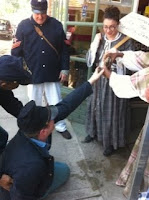
Perhaps the strangest aspect is the frequency of such reenactments. One woman from Montana who used to work for the Department of Defense claimed she used to do just one a month, now spends almost every weekend in the spring and summer devoted to being different Confederate women, prostitutes, dames, abolitionists, and peacemakers. (While she was there, she led a temperance movement and threw all the guys out of the Irish Pub!) She said she liked it because it reminded her of a simpler time and life back home in Montana (though she assured us she saw some interesting things, like events leading up to the Fall of the Berlin Wall, or archaeology in Tel Aviv). She flashed in and out of personae, as if living multiple lives in multiple times and places.


The strangest thing is that all of the reenactors placed their own wishes, desires, doubts, frustrations, and hopes onto this war reenactment. Everything they hated about the government could somehow be in there. Everything they love about a certain lifestyle was suddenly manifest. Some men escaped their boring day jobs as mechanics, store cashiers, or high school students in small towns. Some women escaped their husbands for a little while and found other women doing the same. The war, the Rebel Cause, and the reenactment suddenly became a sort of escape, even despite being a symbol of suffering, division, slavery, and death. These "living historians" preached the truth, just like the Evangelical preacher at the Confederate Sunday Mass claimed. Everyone in the reenactments has their own truth; they choose when they die and when they resurrect (which is ultimately shouted at the end of skirmishes as well!). They choose what kind of history they approve of and which are too simple. (States rights and economy apparently do not go back to the issue of slavery at all, but each reenactor can tell you that the buttons on underwear at the time were made of animal bone, or that train tracks were standardized during the Civil War.)

All and all, this strange phenomenon in American history will be here for a long time. Perhaps as we sit here and dwell on how half a million lives were lost 150 years ago for economics, slavery, belief, propaganda, power, or rights, we should think of our own paranoia, angst, problems, shame, and concerns in an era of struggling economics, bipolarity, and division; let us not let history repeat itself except in a reenactment, on a hot summer day in Lewisburg, in 19th century garments.


Sunday, May 22, 2011

No Mitch; Who?

As you probably have heard, Mitch Daniels is not running for president.

#hopeless

Debt. Debt. DEBT.

My generation is screwed.

What is a liberal girl like myself to do? Obama 2012? c'mon, can't someone give this guy a run for his money?

Wednesday, April 27, 2011

THE DO GOODER

Welcome to my 101st post! (I must be a slacker blogger if it has taken this long...)

Anyways, just wanted to share a new film I starred in called, THE DO GOODER, directed by my dear friends Emmy Pickett and Jimi Patterson. The film is very musical with keen attention to details, rhythm, timing and a core story. I have every song in it stuck in my head and the images (aside from me being a complete narcissist now) are also stuck in my head.

I hope you enjoy it, and tell Jimi and Emmy that you liked it by visiting their vimeo page and giving them loads of compliments.

Check it HERE.

CLICK IT. DO IT.

Love it. Also check out the trailer, which is equally entertaining HERE.

Tuesday, August 3, 2010

Belgrade and the Theater of Necessity


In geopolitical lingo, the word "theater" describes a "region where active military operations are in progress" or more generally "a region where significant events and actions are played out." The world naturally has many theaters of this sort.

Somehow, Belgrade is a true theater, of both the artistic and geopolitical sense of the word.

During my time in Belgrade this weekend, I had the honor and pleasure of visiting with Borka Pavicevic, an iconic artistic, political, social, and activist figure in Belgrade for the past 30 or so years. She is an actress and theater maker by trade and part of the famed Belgrade circle of intellectuals, a now dying or disbanded breed that included Foucault, Habermas, Derrida, and Savic (who I also met) among others. Borka has an air about her. Probably 60 something, she wears slinky shifty dresses, old pearls, dons a bold dark stripe in grey hair, wears deep matte red lipstick, and never is seen without a cigarette. Her deep voice is a strange mix between an old bubby and a sex symbol. Her presence commands attention and her words reveal a depth of understanding in terms easily understood (to agree or disagree with!).
Borka Pavicevic

Today she is a leading chair at the Center for Cultural Decontamination in Belgrade and an active translator, writer, theater maker, and cultural envoy in Europe and the world. She works also with the Youth Initiative for Human Rights--the most effective, organized, and professional human rights agency I've ever witnessed. They have objectives, strategies, and achievable goals to promote democracy, civil engagement, and a revival of Serbian optimism for a new option and new alternative to old Nationalistic discourses that cling to Kosovo at the expense of progress.

As an artist in a theater of operations that has seen Turks, Austrians, Greeks, Romans, Germans, Russians, Internationals, the US, and more, she is very concerned with elements of identity--both as we understand and construct it. The Balkans have historically been a clusterf*ck of identities. In Borka's example: "Former professors of Marxism are now professors of religion!" Particularly now, when old religious and nationalist identities are reemerging in the vacuum of money, stability, and economy in Serbia, identity is a huge issue. She described the reemergence of these beliefs and ideologies--particularly with the Orthodox Church and its relationship to culture and even art.

One of her most memorable quotes to me was this, "A Church without belief is kitsch. Church and the theater require belief, a necessity. With a church, you can build a building and they will come when they need it. With a theater, you cannot just build the building. The people ARE the theater."

Borka, admittedly said that the Theater was mostly disbanded in the 1990s. Today, she is trying to bring it back. As she said, she NEEDS to bring it back to counteract the extremist nationalist, old-school-Serb dialog that holds back a lot of progress in Serbia. The theater gets to those people and the people are going to the theater. As a symbol of progress and peace herself, Borka is shaping a "Theater of Necessity" in Belgrade (not an official title mind you, but concept). There is an agenda in this theater (theater defined here by the people in it), an agenda to salvage, form, and show a process of forming an identity that will move Serbia forward and not keep it back.

The Theater is Necessary because Change is necessary or else Serbia will face dire economic, political, and social consequences (estimated to be on level with those of Greece's recent economic collapse.) When done well, the theater is a machine which we must desire to create and by which we rethink ourselves.

I have been reading current plays from the region, particularly those of Jeton Neziraj, a Kosovar playwright who has gained international renown for single handedly creating a theater in Kosovo, but a theater that actively helps the population rethink war, conflict, and identity. For those skeptics of political theater (I speak to those purists out there!), Neziraj's plays are not solely works of political theater, but are strong piece of literature, regardless of where you come from.

It got me to thinking about my theater. All of these artists are using the theater, not for commercial or entertainment reasons solely, but for a necessary political, ideological, and life-saving agenda. Theater, not just film, has always been a way of bearing witness to people and their actions in a way that film just does not achieve in the same way. It is a near religious experience when done well.

These artists NEED the theater they create and form. It begged me to rethink what I am creating, doing, and saying with my theater.

Immediately after talking to Borka, I contacted several dear theater making friends of mine, calling for a reform of our juvenile theater and coming to a greater intensity of purpose and ideas in what we create. What do we need in creating theater? Why do we need it? Do we even need it?

I beg of you to post responses about what you need in theater.

Responses, however random or unorganized they are, are below:

"I thought how wonderful it could be to teach kinesthetic response workshops to people all over the world. The workshops are aiming to get people in touch with their own center, to respond physically and emotionally to their own complicated thoughts and drives, in a creative, instead of destructive, way; as well as responding to others in the same ways." Timmia HF

"[Theater] goes deeper than that (or perhaps shallower), I'm talking about people like us. not every so-called intellectual is ever going to want to really think. Not every so-called artist is ever going to want to truly create and speak to God. But artists are modern-day prophets." -Timmia HF

"At Yale, in theater, and often, in class, we try to say and do things that are "necessary" because their necessity is a sign of their worth. We want to be good at making theater (or writing essays, talking in section), and surely, a
good theater-maker or thinker would produce work that is "important," "relevant," "vital," and "necessary." I do believe that this compulsive drive toward accomplishment is poison for the thinker and theater-maker. It makes the shows and the papers more boring than a pissing contest.
The question is, what can take the place of that drive? If we are not guided in our thought and in our theater-making by love of praise, what are we guided by?" -Rachel P.

What does she want?
"Choosing/designing projects around what I consider to be theater's greatest asset: the fact that the actor/character may fail to achieve his goal at any moment, that the 2 hours of the play are the only chance, that the audience is bearing witness to a real attempt." --Rachel P

I encourage my theatrical community to continue posting ideas (by choosing to follow my blog!!) and keep this discourse going.

Our theater must be more similar to the geopolitical definition. "A PLACE WHERE SIGNIFICANT ACTIONS AND EVENTS TAKE PLACE."

Saturday, July 31, 2010

The Entrepreneurial Scene in Kosovo

Kosovo is not necessarily the first place you think of when you think "START UP." But like any new born country, you need young entrepreneurs to get things to happen (or at least raise some hell on occasion to get them to happen) . Meet Kushtrim Xhakli (pronounced like "exactly"). A young Kosovar, living in Lithuania, working on his own IT company, maker of trajnimi.com, which brought free IT education to Kosovo, later recognized and picked up by the "European Computer Driver's License" program and one of the contributors to Ipko, one of the few telecom companies and foundations in Kosovo. Yea. All that, and he is 27.

I originally intended to meet Kushtrim for coffee to talk about starting an incubator program for entrepreneurs at the American University in Kosovo. What we talked about was a lot more than that, and quite revealing of the business climate, the cultural climate, the corruption, and the frustrations in Kosovo. Not to mention, Kushtrim himself had a telling story that shunned nationalisms while upholding the basic idea in life, "TO JUST LIVE AND DO!"

We begin with business. He tells me about himself. Being bored with the rather ineffective education he was getting at the University of Prishtina, he dropped out and joined some guys at Ipko, a telecom company that is among one of the most successful, young, and innovative companies. (Recently bought out by a foreign investor for over $300 million or so). Getting the chance to build a company was rare. He began to get involved with the foundation after that, and soon enough, found himself designing trajnimi.com, a free IT education platform, which brought free IT education to Kosovo under the European Computer Driver's License program, software that taught people how to use certain basic programs (Word, excel, ppt) for business. At the time, it was hard to get people to buy it. There was private competition that would not let him enter the market. Some schmoozing with some guys in Politics (this will look good for you if you get elected), and soon everyone in the country had access to this FREE program. Over 18,000 people use it today. His project got him picked up by international news and he got involved with some Lithuanian investors. Today, he runs about 5 different projects.

One of the things he tries to do is introduce third party telecom companies into Kosovo. To him, its been like beating a dead horse. Currently, telecom is in many ways controlled by the state under a group called "PTK." (PTK has been under investigation for corruption for quite some time.) PTK is the telcom and postal authority here. The infrastructure is deteriorating and cell phone use is limited to calls and texts--for the most part in the country. Compared to the rest of Europe, cell phone capability is limited. Kushtrim comes in with investors to open up new companies. Basically, PTK officials say, "No, unless you give us money for a cut that we can take, we won't let you come in." Investors leave, disheartened by the blatant corruption and organized crime within the political parties here.

Kushtrim isn't afraid to say it. He is not afraid to point out that most of the people in the government are making a lot of money and not doing good for the country. Sadly, many of the people his age, who used to be young and idealistic, are trained in the system that has taken over "politics" in Kosovo. They are just as good and trained at taking money than anybody else.

So what does he do? Kushtrim, and a community of people like him, keep pushing the issue. He keeps building his own business in Lithuania (seeing that the Balkans can learn a lot from the Baltics and vice versa). He does not leave Kosovo though. It needs people like him. Revolutionary thinkers who know how to work through the bullshit and get something done (the program under European Computer Driver's License for example).

Patriotism for a working Kosovo comes in his blood, though not along ethnic lines--this brand of ethnic nationalism captures the minds of many young people. Kushtrim's father and siblings are painters and his mother teaches Ethics. Back during the war, Kushtrim's dad printed a magazine called, "Uprising" about independent Kosovo. It was distributed in Kosovo, but when his partner was caught and killed by Serbians (Milosevic's men), the "Xhakli" name was blacklisted by those Serbs. Fellow Kosovar Albanians next door (in the neighborhood) did not protect them, but booted them out for fear of their own welfare. They fled to Macedonia then Germany in cognito.

Naturally, after such experiences, Kushtrim is far from being an "Albanian Nationalist" and has, in his mind, more important things to do than argue who was in Kosovo first--an common discourse here. Kushtrim is, however, a patriot. He needs to bring in companies, bring in investors, and get past the bullshit that is plaguing Kosovo both on the international and domestic fronts. He sees the beauty and possibility of this New born Place ("way less boring than a place like Denmark or Sweden!" as he says). He won't give up on Kosovo. He holds Kosovo and its people accountable for what is happening there now.

In the mean time, he will live a humble life that Facebook pictures won't reveal (Portugal, London, Geneva, Monte Carlo). Traveling to San Fransisco next week, he will take on the giants of "Venture Capitalists." ("Not too different from Kosovo politicans" a friend told him. He should be fine).

His advice to Kosovo? "Just DO something with your life!" Its not about serbs or albanians, its about living a decent life, regardless of who or what or where you are. DO something! CREATE something! He is a living example of alternative life, education, and credentials.

The life on the unworn track is far more interesting after all.

Sunday, July 18, 2010

Internal Conflict: Keeping your head with your heart in Kosovo

When I try to tell my parents over Skype what I see here, the first thing they may ask "Are you safe? Don't cause trouble. Don't get hurt."
Don't get hurt.
C'mon. This is Prishtina. Generally speaking, a safer place than New Haven, CT. But sorry to report, I have been "hurt" here.

Look, I'm not going to pretend that I am "hurt" more than someone who actually experienced the war. Not for a minute. However, let me explain.

Truth be told, trying to understand a conflict is not as easy as passive observation. It takes a desire to understand suffering, hate, violence, strategy, injustice, defense, aggression, economics, politics, law, and power. To see all of this played out on a daily basis, even 11 years after the war, and 6 years after major uprisings... well, lets just say it takes its toll. It hurts the most optimistic of optimists. And I tend to be cynical.

In reaction to injustice, corruption, hatred, defensiveness, and politics, I feel a strange sense of idleness, inability, frustration. I get angry having been thrown into a room to discuss (for 9 hours each day) the politics of conflict, listening to who was hurt more, and seeing the anger and frustration between Serbs and Albanians in the classroom (some of whom had family members in the Kosovo Liberation Army (KLA) and had family members die either from airstrikes or people). After a while, the anger, frustration, prejudice, and politics get to you. You can no longer passively sit, watch, and understand. Unless you (as the "western observer") check your emotions from time to time, they can consume you. At a certain point, your blood boils and reason is lost. Then you realize, "Shit son! This is conflict!"

Let me explain a day in my life here to elaborate:

Friday: A panel between two journalists, one Serb, Nenad Maksimovic and one Albanian Kosovar from the BBC, Arber Vllahu, and the moderator, a Kosovar Albanian, Behar Zogiani. The panel is "supposed" to be on how to conduct ethical, unbiased journalism in a warzone.

The speech begins with Arber saying that what happened in 1999 was a "genocide." He goes into a description of his personal experience of people being tortured, and wounded.

Yea. The room gets heated. The Serb rebuts with numbers (a quick fact check follows by everyone in the room). Then, all of the Albanian Kosovars in the audience sit up in their seats, start shouting out loud at the Serb, trying to convince him it was a genocide, or ethnic cleansing. A genocide, defined by article two of the United Nations Convention on the Prevention and Punishment of the Crime of Genocide, is "any of the following acts committed with intent to destroy, in whole or in part, a national, ethnical, racial or religious group, as such: killing members of the group; causing serious bodily or mental harm to members of the group; deliberately inflicting on the group conditions of life, calculated to bring about its physical destruction in whole or in part; imposing measures intended to prevent births within the group; [and] forcibly transferring children of the group to another group.". I am not here to tell you what I think about whether it was a genocide or not (Noam Chomsky, for instance says no). There is no UN ruling or court ruling that what happened in Kosovo was a genocide. However, the Jews in the audience are getting frustrated and upset that the "G" word is applied to something they think it is not. Everyone has a conflict, an experience, a suffering, or a side to defend. Both my friend Anastasia and I ask if the moderator could clarify the argument. He had let it go unchecked up to that point.

As the conversation continues, you get more attempts at "who was hurt more and why" in the conversation. The politics in the room are heating up and soon some of the staff of the university chime in their two bits. A lone Serbian student in the room asks for respect--it was Milosevic, not him or the journalist on the panel, who conducted the horrors of 1999.

The BBC journalist is trying to uphold his unbiased view towards news. The Serbian is trying to not be the "ugly Belgrade Milosevic lover" in the room. I get so fed up with "I AM AN UNBIASED JOURNALIST" defense that I ask about the media's role in the 2004 uprisings, where 3 Albanian kids drowned in a river. The TV blamed it on the serbs and consequently riots broke out, hundreds of churches were destroyed and people (mostly serbs) were killed or thrown out of their houses. HOW can media be unbiased in a place where Albanian flags and Serbian flags still mark territory as if Kosovo itself did not exist? I get the confession, "MEDIA IS BIASED IN KOSOVO" straight from the horses' mouths.

The question remains, "Why did I want such a confession? Why did I feel so angry at both parties for their fighting?"

I leave the room wanting to crawl under a table. My blood is boiling with a frustration, "DON'T THEY REALIZE THIS FINGER-POINTING IS WHY THEY ARE STILL SUFFERING?" I can try to empathize, but I want peace. There are frustrations running all over the place by westerners in the class who just do not know what to think or do now. When you have never had to experience war, empathy may be there, but how much do we really understand the psychology of war? Its easy for me to see this, but I did not have an uncle shot by Milosevic's guys or a church burned.

Fast forward to later in the day. I'm already sweating bullets. I'm riding a cab to a group of Serbian refugees who live in shipping containers (and have for 11 or 6 years, 1999 or 2004 being the move-in date). They sit on their "porches" and usually share cigarettes, jokes, and grievances. Most are old Serbs, still fighting land disputes with Albanians.

One woman, Toni Schmilka, has been there for 6 years. In 2004, a group of Albanians brutally beat up her husband and kicked them out of their apartment. Today, an Albanian lives there. When her husband went back later (even to collect bills in his name there...), he fought with the Albanian. He had a heart attack in his car from the stress, and died. Toni is now fighting a legal battle for the land, but all of the judges are on vacation and there are way too many cases like hers for anything to happen quickly.

The refugees may have families in Serbia, but they do not live with them. Many of the refugees are older, very sick, in need of medicine, and more. They do not go hungry but eat moldy bread. They cannot get jobs. Even Kosovar Albanians cannot get jobs when 40% of the population is unemployed, and its worse for Serbs. Soon, KEK, the Kosovar power plant will start charging them for electricity. KEK does not employ Serbs and will be privatizing soon, so no hand outs to Serbs. The Serbian government does nothing for them. The Ministry of Returns and Refugees in Kosovo does nothing.

All I could do for these guys was share some fancy Djarum cigarettes I brought for them. Its about the nicest thing someone has done for them in a while. I didn't want to make any more empty promises.

The thing that angered me even more was the man with 7 children who moved there 3 months ago because of a land dispute with a brother serb. He was shouting at his wife and demanding that my russian friend Anastasia get Russia to do something for them. His daughter was dying of brain cancer.

So I sat there, angry at the Serbs, the Kosovars, the Albanians, the Serbian government, this asshole who could not take care of his 7 kids, all the while, this blind girl dying of a brain tumor traced the lines of my Orthodox cross bracelet. She pulls me close to her and kisses my cheek when I leave. I look at the eyes of a Canadian girl with me. The sense of inability, confusion, and frustration was enough to make me call a cab early and leave.

Later that day, a man came up to me in a cafe, shouting at me in Albanian. I didn't know what to do. Later, I found out that he was upset that I was an Albanian who did not speak Albanian. That I was forsaking my people. That I should be ashamed at my inability to connect to my people. I had enough.... I told him I was an American so he should just speak English to me or leave me alone. Apparently I look like an Albanian.

Later again, a man grabbed my sweater in the street and I screamed at him. I suddenly was filled with so much rage.

I can only tell you that later that night, someone asked me what I was doing in Kosovo. I was too emotional to answer. Even to someone I love, I lashed out, "I DON'T KNOW! I DON'T UNDERSTAND IT! I FEEL SO FRUSTRATED I CAN'T TAKE IT HERE! I HATE THE POLITICS! I HATE THE LACK OF ABILITY! I HATE THE ALBANIAN NATIONALISM! I HATE THE SERBIAN INABILITY TO HELP THEIR OWN REFUGEES! I CANNOT STAND THE POLITICS OF EVERY CONVERSATION! I DON'T KNOW WHAT I'M DOING HERE SO DON'T ASK!"

Later, I calmed down. I realize what I was doing. I was beginning, ever so small and minutely, to understand conflict. I was understanding pieces in the chess puzzle of conflict, and not just as another law student studying Kosovo from afar, but as a human being.

I started writing a short story.

How do you keep a mind and heart in check? How do you keep your head when conflict and violence are not there "to make things clear," but rather confusion, frustration, nationalism, hate, prejudice, and pain that you don't understand? I had been feeling these things and the fact that I felt them scared me.

I realized that I would have to continue observing, feeling, hurting, but making sure to keep my perspective. I really am learning something and understanding some of the most ugly and beautiful interactions we humans must face.

I know I have not expressed every "side" here, or everyone's experience. I have listened to the grievances of Albanians from the time before 1999. I have visited Reycak and seen the graves of the massacre there. I have listened to Serbs talk about their houses being burnt down and their husbands beaten to death in 2004. I have listened to Albanians tell me about how they watched their families killed in front of their eyes by the hands of Milosevic's army.

It hurts me. I cannot deny it. Of course not as much as they have. The first problem a "third party" faces is the feeling of inability, the feeling of the need to take sides in order to "help." Feeling these frustrations, seeing the suffering, all of this hurts you. You can't understand why they cannot understand that these ethnic hatreds are what perpetuate conflict. Yet at the same time, you know they that even though they may know this, psychology is a funny thing. Death and war does hard things to the mind. Hurt continues.

What I have written here has not come to any conclusion on "who was right and who was wrong." I only wanted to show the mental difficulty of all sides in trying to move on (or understand) after conflict. This is written for those abroad, who have not seen such things as Kosovo. Those Kosovars here, (whether you are Albanian, Serb, Turk, or Egyptian), please understand that I do not want to take sides. I only want to show something to those at home that this conflict is not so easy as they may think. I'm sorry if I have offended anyone, I do not mean to. I am sorry for what has happened to you. I will empathize, but never enough for what you truly deserve. Yet you have a heavy and hard job now to make peace. Change history. Just because fighting happened before, does not mean it has to continue. I have faith in you.

Wednesday, July 7, 2010

"The Sun Rises in the West"

When the UN and NATO sought to create a stable multi-ethnic society in Kosovo, I don't know if they envisioned a multi-national society as it is now. Walking down the streets, you see more Norwegian NATO, American lawyers, Austrian bankers, and Turkish businessman more often than not. An Albanian once joked with me, "Because I'm an Albanian, I am a minority here." Talk to many Albanian Kosovars here, and they will tell you they like the international presence. They are thankful for it. As the joke goes, "The Sun rises in the west for Albanians." The society here attempts to adopt the styles, the fashions, the look and feel of the West (whether by choice or by the forces of internationalization of the region... you choose).

In reality, UNMIK, EULEX, and K-FOR sought to create a multi-ethnic society where the Albanians, Serbs, Bosniaks, Turks, Christians and Muslims could live in peace. Generally, society is getting along with help of international security and heavy policing, but some ethnocentrism and blood feuds from the war and ongoing conflict remain. For instance, the divided city of Mitrovica, where Serbs live in the North of the central bridge and Albanians live in the South, there is still ethnic violence. A few days ago, a grenade went off killing one. Ethnic tensions still exist, even as a lot of the population westernizes or caters to international expectations.

All of the ethnic divides in a NATIONAL population of around 2 million are a cause for concern for the population living there. Can 2 million people of different faiths, ethnicities, and historical antipathy towards one another really live together as such distinct identities? To many, the answer is no. The result? The government tries to homogenize some of the most obvious outliers of the population. They try to ban Muslim headscarves first of all from public places. The result? A huge protest of 1,000 people wearing traditional Muslim garb. Two days ago, a Kosovar Serb Parliamentarian went to North Mitrovica to convince the Serbs there (still living under Serbian flags, Serbian money, and no license plates), to accept Kosovo's legitimacy and government and was consequently shot in the leg.

Trying to force the population under a single identity is not easy. Clearly.

One wary taxi driver once told me, "We have to be the same. We cannot have one foot in the West, one arm in Islam, one head in Albania, one leg in Austria, one hand in Serbia, and this idea that we are still Kosovo. It is not possible."

Can Kosovo be a multicultural America with such a small population? As they say here, "What to do..." No question mark.

PS Keep your eye out on my piece of Journalism about Serbian Refugees.


Tuesday, January 26, 2010

Keep an eye on it---- what does that mean?

While I was breaking bread with the dead, reading Cicero, and y'know, being a Yale student (how ridiculous that sounds sometimes in the 21st century!), someone asked me, "Can you keep an eye on my computer for me?" I of course replied, "Of course!" However, what does this even entail?
I've often wondered about the Good Samaritan principle in American culture. Do we really look out for each other and make sure that no one steals the other one's stuff? I have a hard time getting someone to hold a door for me, let alone getting someone to make sure some stranger doesn't steal my computer. So the question arises, "Should I even ask? Would they do it anyway?"

Next question: Would someone stop someone from stealing my computer? Would they scream, "Stop thief!" or would they quietly report it to police and take down a composite drawing of the culprit. Would they take responsibility for letting someone take my computer? Or would they say, "It wasn't my responsibility, get a security tracker."

These things I have often times wondered. Hold on, I have to keep my eye on this black HP PC laptop... even though I really have to go get Claire's cake with Misha right now....

Thursday, October 15, 2009

Business Practices That LIVE

Run a healthy, environmentally friendly business. CSR (Corporate Social/Sales Responsibility) can mean serious cash and serious humor.

You may not see how these things connect, but after my Arabic test tomorrow, oh will I tell you.

This just made my night.

Going loopy with work,
Danielle

Sunday, October 11, 2009

Dear Enron: Are we screwed?

Dear Enron--

I visit your tomb today to ask, how many more are like you out there? How many more clever systems are writing off debts that the public cannot see? How many more of you are hiding information and thus creating an unfair market? How many more are keeping our failing economy running on a lie?

If the system is defunct, then we are screwed. Ultimately, you failed because prices caught up to you. Even if you perfect your lies, are we safe from another major market failure? Lies in subprime markets.... lies in Enron.... Where are there more lies that will catch up when there is another change in global markets?

My question is, Enron, should I pack up and go live on a kibbutz? Should I go live on a self sustaining farm in Syria while learning Arabic--as is my dream?

Though dead, Enron, you teach me some scary things. You teach me that this is not unusual and that it is perfectly possible to cover up lies for a long time. If capitalism is suddenly based off of these lies, thus becoming a "failed capitalism," then are we screwed?

I don't like apocalyptic narratives, but this is starting to sound like one. Who needs the class on "Apocalyptic Narratives in American Culture" that American Studies puts out? This is the big daddy of Apocalypse.

Oh how I remember the days when I thought capitalism was so light and fluffy and fair, when we worshipped it at Christmas with the success of marketing triumphs at Brookstone and Toys R' Us. Communism sucks. Facism sucks. Socialism sucks. Mercantilism died. They are all imperfect eventually. What are we going to do?

God I should get some sleep. Oh Enron. I am making no sense because your class is sucking my brains out of meeeeeeeeeeee.

asldkfj ;lawueoir

Yours,
Danielle

Thursday, October 8, 2009

Dear Enron

Dear Enron
cc: Activists who hate capitalism, mass media
bcc: Douglas Rae

How do you think Off-Balance sheet partnerships are in any way ethical? Just because they are legal does not make it ethical. Is not one of the first rules to successful capitalism (according to Adam Smith) transparency and freedom of information? Oh, when the days of business were noble and honorable! (At least in my nostalgia for days I've not seen).

But even more so, thank you for making capitalism look more evil than a vengeful demon mask in Japanese No drama. Thanks to you, mass media can make big business (and therefore, most business) look evil to the eyes of the world. Not only does your complexity make you unethical, your complexity makes mass media simplify you to make business seem evil. Oh if only we could reform!

Thanks to instances like this, America has no clue what's going on and they protest things they do not understand. No wonder there. But just the sound of "off-balance" sheet partnerships makes me nauseous too. Yet I am not prone to protest.

Yes, I understand you collapsed in 2001 and this story seems like old news, but why do I feel like you are still haunting me? Perhaps because I have to write a paper on you due Monday.

Sincerely,
Danielle